
Can You Use a Normal SIM Card for Telecalling? What Actually Works in India
Yes — you can make business calls from an ordinary SIM card, and lakhs of Indian sales teams do exactly that. There is no rule stopping you. The problem is what happens next: a personal SIM used for 200 outbound calls a day gets reported as spam, none of those calls reach your CRM, and when a rep leaves, their call history and customer relationships leave with them.
So the honest answer is that a normal SIM works technically but fails operationally. Below are the four options actually available to Indian teams, what each one costs, and where each one breaks.
Option 1: Personal SIM, called manually
This is where almost everyone starts. A rep uses their own phone and their own number.
What works: zero setup, zero cost beyond the existing recharge, and the customer sees a normal mobile number — which is answered far more often than an unknown virtual line.
Where it breaks:
- Spam flagging. High-volume outbound from a personal number gets reported, and once carriers or apps like Truecaller mark it, your pickup rate collapses.
- Nothing is logged. Call outcomes live in the rep's memory. Managers ask for updates instead of looking them up.
- You don't own the relationship. When the rep resigns, the number goes with them. Your customers keep calling a person who no longer works for you.
- No recordings. Disputes about what was promised come down to whoever sounds more confident.
For a two-person team making a handful of calls, this is fine. Past roughly 30 calls a day, it stops being viable.
Option 2: A dedicated business SIM
The same as above, but the SIM belongs to the company rather than the rep.
What this fixes: you own the number. Reps come and go, the number and its history stay. Business connections also tend to handle volume better than consumer plans.
What it doesn't fix: logging, recording and visibility. You still have no record of what happened on any call unless somebody types it in — which, in practice, they don't.
Option 3: A VoIP or cloud telephony dialer
Here calls route over the internet from a virtual number, usually with an IVR, call queues and recording included.
Where VoIP genuinely wins: a desk-based contact centre with reliable bandwidth. Inbound routing, extensions, queueing and simultaneous ring are things SIM calling simply cannot do.
Where it struggles in India:
- Pickup rates. Customers screen unfamiliar virtual numbers, and once a VoIP range has run outbound campaigns, it gets flagged faster.
- Bandwidth dependency. Call quality is entirely a function of your connection. On mobile data, while travelling, or outside metros, you get lag and dropped audio.
- Per-minute cost. VoIP typically bills per minute on top of the subscription. For a team making hundreds of calls a day, that becomes the largest line item.
Option 4: SIM-based calling connected to a CRM
This is the option most Indian teams end up at, because it keeps what works about a normal SIM and fixes what doesn't.
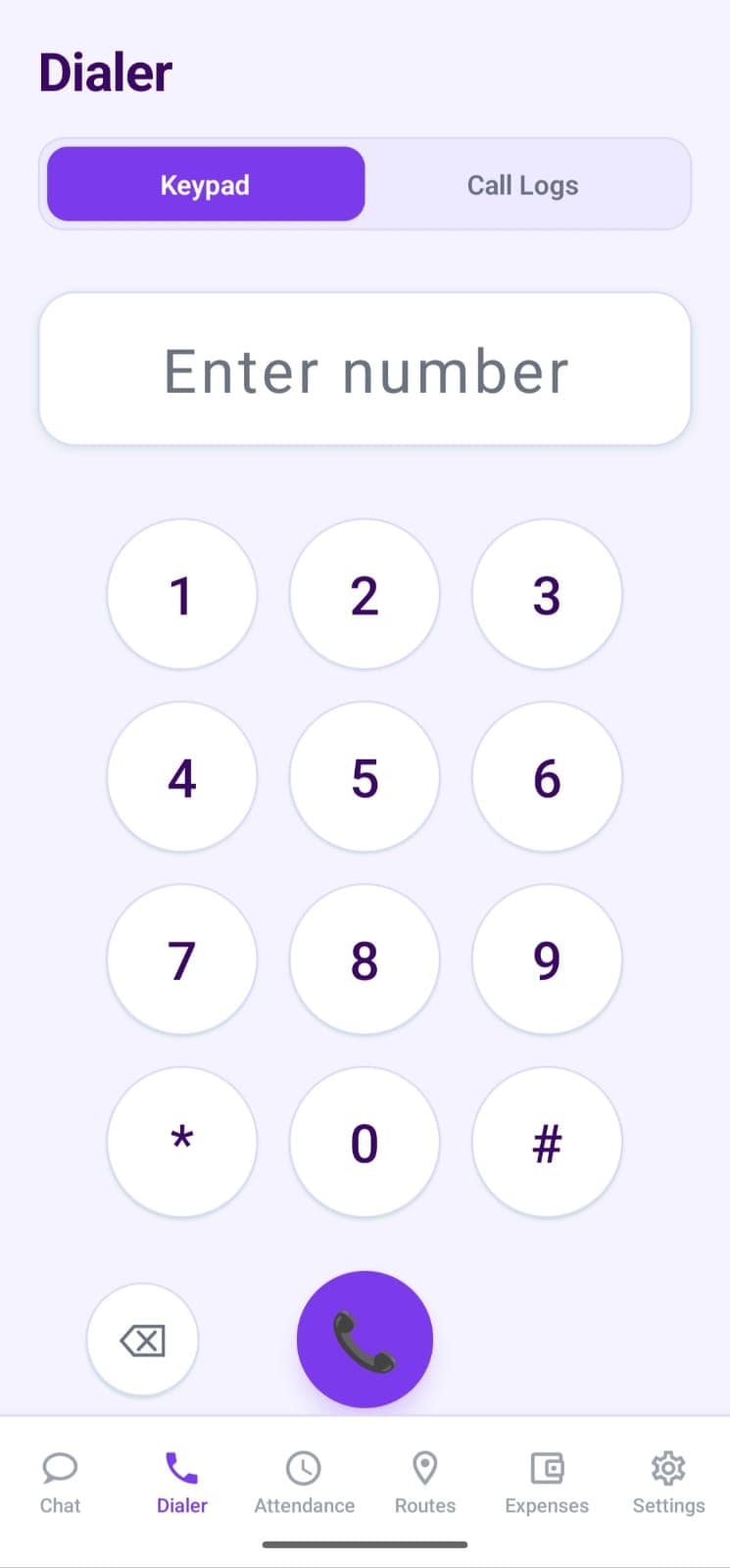
The rep still calls from their existing business SIM, over the mobile network, so the customer sees a familiar number and quality doesn't depend on data speed. The difference is that an app links the call to the customer record: duration, direction, recording and the outcome the rep taps all save automatically against the right lead.
What you get that a plain SIM cannot give you:
- Every outgoing and incoming business call logged against the customer, with no typing
- Recordings attached to the contact for coaching and dispute resolution
- One-tap dispositions that schedule the follow-up automatically
- Agent-wise dashboards — calls attempted, connected, talk time, follow-up compliance
- Missed inbound calls surfaced with timestamps, which is usually where lost enquiries hide
What it still cannot do: inbound IVR menus, call queues and extensions. If you need those, you want cloud telephony for the inbound line, and many teams run both — SIM-based calling for outbound sales, cloud telephony for support.
Which one should you choose?
Work backwards from where your team actually sits.
- Fewer than 30 calls a day, one or two people: a business SIM is enough. Don't over-buy.
- A telecalling or field team on mobiles: SIM-based calling with CRM logging. You keep the pickup rate, and you stop losing the data.
- A desk-based inbound contact centre: VoIP or cloud telephony, for the routing and queueing.
- Both motions in one company: run both. This is common and perfectly sensible.
The mistake to avoid is choosing VoIP purely because it sounds more professional, then discovering that your field reps can't hold a call in a lift and your pickup rate has halved.
A note on compliance
Recording business calls is standard practice in India, but consent and retention requirements vary by sector — BFSI and healthcare in particular have specific obligations under their regulators. Whichever option you pick, confirm your consent process with your compliance advisor, and check that recordings are stored securely with defined retention and audit access. Where the data is hosted matters too if you handle regulated customer information.
FAQ
Can I legally use a normal SIM card for business telecalling in India? Yes. There is no restriction on making business calls from an ordinary SIM. The practical constraints are commercial rather than legal: personal numbers used for high-volume outbound get flagged as spam, and calls made this way never reach your CRM, so you lose both pickup rate and data.
Why do calls from a normal SIM get marked as spam? Spam classification is driven by user reports and calling patterns. A number placing many short outbound calls to people who have not saved it looks like spam behaviour to carriers and to apps like Truecaller. Once flagged, a growing share of your calls go unanswered.
Is SIM-based calling better than VoIP for Indian sales teams? For mobile-first teams, usually yes — better pickup rates because the customer sees a normal mobile number, call quality that doesn't depend on bandwidth, and no per-minute software charges. For a desk-based inbound contact centre that needs IVR, queues and extensions, VoIP remains the right architecture.
Do reps need a second phone or a new number for SIM-based CRM calling? No. They use the business SIM already in their phone and dial as they normally would. The CRM app captures the call activity in the background, so there is no new number to provision and nothing new for the rep to learn.
How do calls get recorded and saved to the CRM? An app on the rep's Android phone links each call to the lead being dialled and reads the device call log for business calls, then attaches duration, timestamp, recording and the disposition the rep selects. Nothing needs to be typed for the call itself to be logged.
What does SIM-based calling with a CRM cost? NeeN AI plans start at ₹599 per user per month with a free trial. Because calls run on the rep's existing carrier plan, the software adds no per-minute charge — which is the main cost difference versus VoIP for high-volume outbound.
Where to go next
If you're evaluating this for a telecalling team, start with SIM-based CRM to understand how the logging works, or read the full SIM-based calling vs VoIP comparison. If you need an auto-dialer for a call list, see SIM Dialer. For inbound routing alongside outbound, 9ance Telephony covers the cloud side.
Tags

About Editorial Team
Editorial Team is a contributor to the 9ance blog, sharing insights about CRM, productivity, and business optimization.
Enjoyed this article?
Share it with your network!
Stay Updated with Our Latest Insights
Get the latest CRM tips, productivity hacks, and industry insights delivered straight to your inbox.